This box lives at How To Do Research > The Research Process
It is included on the
- What Have Others Said About This Topic?" (Scholarship as Conversation) page of the Reading & Writing Intensive Canvas Module
- Evaluating Sources page of the Nursing Library Module Canvas Module
Scholarship as Conversation
Chances are you're not the first person to research your topic. Before beginning your research assignment, it's a good idea to explore what "literature" has already been published on your topic. In this case, "literature" refers to any previously published article, video, book, or other resource. By seeing what others have already found on your topic, you can see whether a consensus has been reached, and what aspects of the topic have not been explored. Knowing what has already been published on your topic will ensure that you include the most up-to-date research and findings in your paper, and avoid redundancy in what you research and write.
This video will help you:
- Understand how scholars communicate new discoveries with one another.
- Identify avenues for contributing to scholarly conversation.

Misinformation
This box lives at How To Do Research > Evaluating Information > Misinformation & Fact Checking
It is included on the
- Evaluating Information - Misinformation & Fact Checking page of the English Comp Canvas Module
- Evaluating Sources page of the Nursing Library Module Canvas Module
Understanding Misinformation and Disinformation

Every day, millions of people create and share content online. How much of it is really accurate? The trouble with the digital environment is that it's very easy for context to be taken out of context, which can make facts look like fiction and fiction look like fact.
Here are some key terms to help understand the different types of false information that we see online:
- Misinformation: False information shared by people who believe it is true.
- Disinformation: False information intentionally created to mislead people. (The creators know that it is false.)
- Fake news: Disinformation that is designed to look like real news, often for commercial or political reasons.
- Note: Some public figures use this term to discredit legitimate sources that they disagree with.
- Satire: A critique in the form of exaggeration or irony, often focused on news or current events. Satire is not meant to mislead, so the creators or site will identify it as satire. If you share it, you should identify it that way, too!
Why It Matters
Intentional or not, sharing false information can have real-world consequences. We all share the responsibility of stopping its spread by being critical consumers of information and checking our sources before we share something online. It's easier than you might think! The strategies outlined in the SIFT method are a great place to start.
The SIFT Method for Online Sources
This box lives at How To Do Research > Evaluating Information > The SIFT Method for Online Sources
It is included on the
- Evaluating Information - The SIFT Method for Online Sources page of the English Comp Canvas Module
- The SIFT Method for Online Sources page of the Evaluating Sources Canvas Module
- Evaluating Sources page of the Nursing Library Module Canvas Module
The SIFT method outlines four moves that you can use to quickly check the reliability of information. While the focus is on online resources, it can be applied to any information that you want to verify. Rather than being a checklist of things to look for, it focuses on habits that you can use to save your energy for digging deeper. The goal is to understand the information's context so that you can evaluate it effectively.
This box lives at How To Do Research > Evaluating Information > The SIFT Method for Online Sources
It is included on the
- Evaluating Information - The SIFT Method for Online Sources page of the English Comp Canvas Module
- The SIFT Method for Online Sources page of the Evaluating Sources Canvas Module
- Evaluating Sources page of the Nursing Library Module Canvas Module
 STOP
STOP
When you encounter new information or a new resource, stop and take your bearings. Ask yourself: Do I know and trust this website? If not, use the other moves to learn more about it before you read or share.
You also want to stop periodically while you work through the moves to make sure you haven't gone down a rabbit hole. Remember, these strategies are meant to be fairly quick. If it's taking you a long time, check your strategy and make sure it's working.
INVESTIGATE the Source
Find information about the source from other sources. Ask questions like:
- Is this a reputable publisher?
- What is the author's expertise on this topic?
- Who funded the publication?
Investigating a source can help you contextualize the information and uncover hidden biases. You want to know if the economics article you're reading was written by a Nobel laureate economist. You also want to know if the video you're watching about the health benefits of milk was put out by the dairy industry. It isn't because the Nobel prize winner is always right about everything or because you can never trust the dairy industry, but knowing that context impacts how you are going to approach the information.
FIND Trusted Coverage
Sometimes the article or video you found doesn't matter as much as the claim it's making. In that case, choose some keywords to search. If it's a current event, try using the news filter on your search engine.
- Can you find at least one, but preferably more, trusted source that's reporting on the claim?
- Do all the sources seem to agree on the claim?
- Is there controversy around it, with different sources making conflicting arguments?
Knowing whether a claim is widely accepted or still hotly debated provides more context for you to use as you evaluate it.
TRACE Claims Back to the Original Context
Track the facts or data back to the original source to make sure they weren't taken out of context. Some things to consider:
- A video shows two people fighting. Is there a longer version? Was part of the video deleted? What happened before filming started?
- News articles reporting on new research may, intentionally or unintentionally, misinterpret the research. Find the article and read it yourself.
- A photograph may be real, but may be presented with a falsified caption. Do a reverse image search to see where it really came from.
The context in which something happened or information was created influences its meaning, but many things online are taken out of context for a variety of reasons. Understanding that original context will help you evaluate your information effectively.
This box lives at How To Do Research > Evaluating Information > The SIFT Method for Online Sources
It is included on the
- Evaluating Information - The SIFT Method for Online Sources page of the English Comp Canvas Module
- The SIFT Method for Online Sources page of the Evaluating Sources Canvas Module
- Evaluating Sources page of the Nursing Library Module Canvas Module
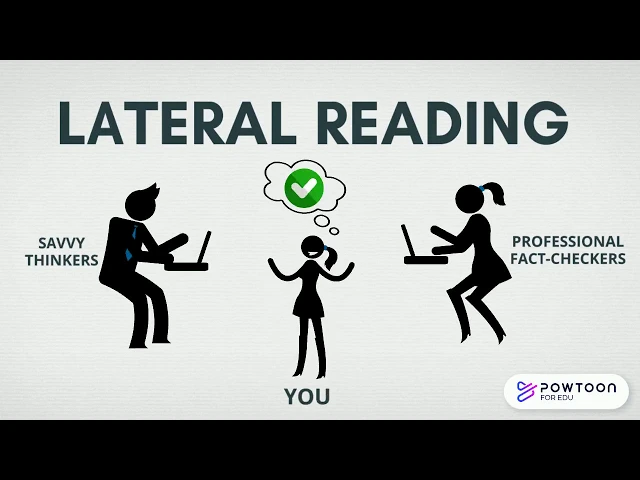
Lateral Reading
When you investigate a source, you don't want to rely only on what the creators tell you about themselves. You want to know what other sources say about them before you continue. Professional fact-checkers use a simple strategy called lateral reading to quickly and accurately determine the reliability of a source in just a few steps:
- Open a new tab
- Do a search for the website's title or publisher or the article's author
- Look through the results that you get and choose a few to click on for more information
Doing this helps you determine who is really behind the information you've found, which is key to evaluating and analyzing it.
This box lives at How To Do Research > Evaluating Information > The SIFT Method for Online Sources
It is included on the
- Evaluating Information - The SIFT Method for Online Sources page of the English Comp Canvas Module
- The SIFT Method for Online Sources page of the Evaluating Sources Canvas Module
- Evaluating Sources page of the Nursing Library Module Canvas Module
The SIFT Method portion of this guide was adapted from "Check, Please!" (Caulfield). The canonical version of Check, Please! exists at http://lessons.checkplease.cc and licensed under CC-BY. As the authors of the original version have not reviewed any other copy's modifications, the text of any site not arrived at through the above link should not be sourced to the original authors.